Redmond's Peanut Free Facility & Foods
<h1>Redmond's Peanut Free Facility & Foods</h1> Health Facts |

Health Facts

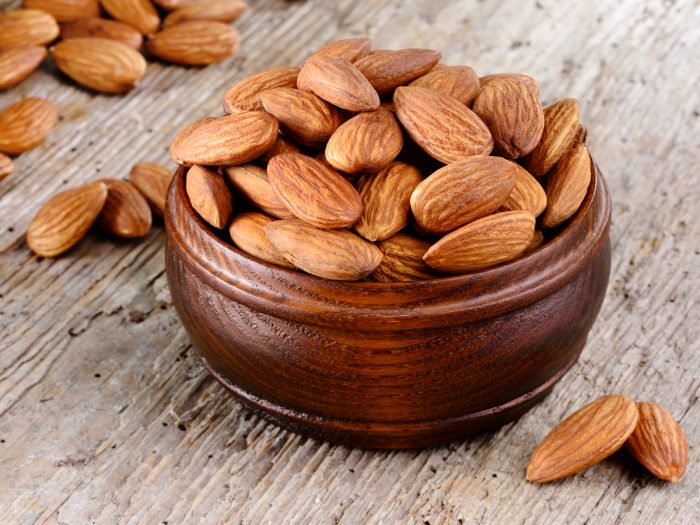
Almond facts:

Almonds provide high quality, highly absorbable protein. What does quality protein mean and how is it measured? Protein quality is measured by the number of essential or indispensable amino acids provided and by the digestibility of the protein.

-(http://www.formerfatguy.com/articles/almonds.asp)

Almonds are high in monounsaturated fats, the same type of health-promoting fats as are found in olive oil, which have been associated with reduced risk of heart disease. Five large human epidemiological studies, including the Nurses Health Study, the Iowa Health Study, the Adventist Health Study and the Physicians Health Study, all found that nut consumption is linked to a lower risk for heart disease. Researchers who studied data from the Nurses Health Study estimated that substituting nuts for an equivalent amount of carbohydrate in an average diet resulted in a 30% reduction in heart disease risk. Researchers calculated even more impressive risk reduction–45%–when fat from nuts was substituted for saturated fats (found primarily found in meat and dairy products).

A study published in the British Journal of Nutrition indicates that when foods independently known to lower cholesterol, such as almonds, are combined in a healthy way of eating, the beneficial effects are additive. In this study of 12 patients with elevated LDL cholesterol levels, a diet containing almonds and other nuts, plant sterols (also found in nuts), soy protein, and soluble fiber (in high amounts in beans, oats, pears) reduced blood levels of all LDL fractions including small dense LDL (the type that most increases risk for cardiovascular disease) with near maximal reductions seen after only 2 weeks.

-( http://www.whfoods.com/genpage.php?tname=foodspice&dbid=20)

The presence of powerful nutrients like proteins, dietary fiber, mono unsaturated fatty acids (MUFA) and Vitamin E make almond a rich diet source for combating degenerative diseases such as diabetes and heart diseases.

Almonds are among the best whole food sources and the bet nut source of alphatocepherol form of Vitamin E. The U.S. National Academy of Science (NAS) recommends consuming 15 milligrams of alpha tocopherol Vitamin E per day. Alpha-tocopherol is one of the form of Vitamin E that is most efficiently used by the human body

Latest research has shown that a moderate-fat almind-containing diet results in greater satiety and sustained weight loss as compared to a low fat diet containing the same amount of daily calories.

-( http://www.healthtips.in/almond_myths_and_benefits.asp)

Facts About Gluten & Trans Fat

Gluten:

Food allergy remains one of the most persistent forms of allergic reaction. No one knows why people have certain allergic responses to different types of food. But it is a fact that once a person is exposed to the food allergen, the symptoms will surely follow.

Gluten allergy is a food allergy that makes the sufferer sensitive to gluten. Coeliac disease is a health condition in the small intestine. What happens to a person with gluten allergy is once the allergen comes in contact with the small intestine, it causes the immune system to attack the lining of the bowel.

-(http://www.myyogaonline.com/healthy-living/nutrition/facing-the-facts-of-gluten-allergy)

Trans Fat:

1. Trans fat is found in shortenings,  margarine, snacks such as crackers, candies, and cookies, fried foods, pastries and other  foods prepared with partially hydrogenated vegetable oils.

2. Hydrogenation is the process of bombarding an oil’s fat molecules with hydrogen atoms, making it more dense and raising its melting point, so that the oil becomes solid at room temperature.  An unfortunate side effect of this the creation of trans fatty acids. Partially hydrogenated oil means that the hydrogenation process stopped short of a full solid, reaching a more creamy, semi-soft, butterlike consistency. This is the story of margarine.

3. Cis and trans are terms that refer to the arrangement of chains of carbon atoms in a fat molecule. hydrogenation turns cis  into trans.

4. Some margarine brands use fractionated oils instead of partially hydrogenated oils in order to eliminate trans-fat. The fractionation process involves heating then cooling a liquid oil, thus separating it to fractions that have different melting points. Unfortunately, this process raises the level of saturated fat in the oil.

5. Trans fat labeling on food packages has been mandatory since 2006.

-(http://www.fooducate.com/blog/2009/02/10/ten-trans-fat-facts/)

Tuesday, January 19th, 2010 Health Information

No comments yet.

Leave a comment